

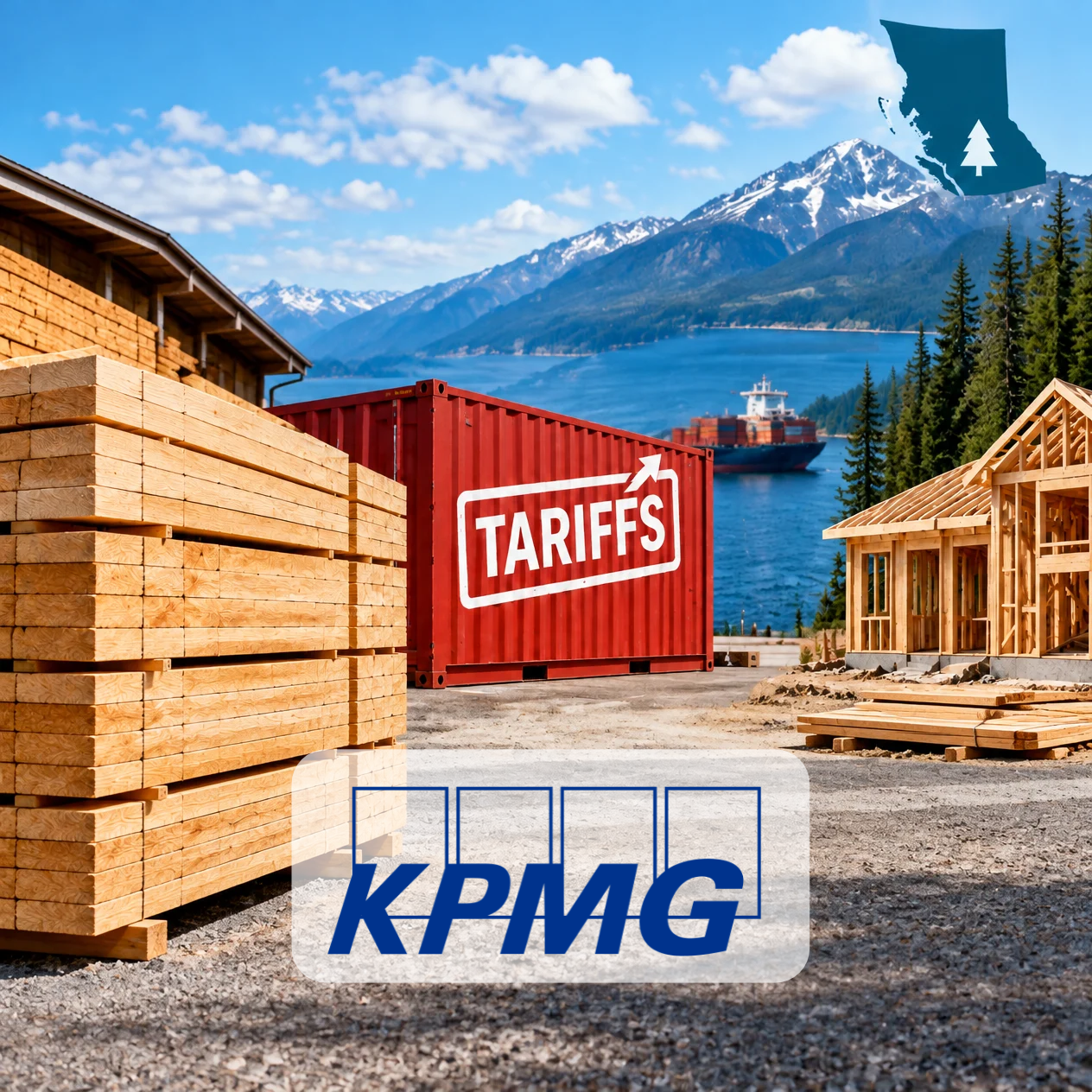
13 Oct The Impact of Tariffs on B.C.’s Lumber and Building Products Industries
BSIA is pleased to share the following industry insight from our partners at KPMG, looking at what the latest trade measures mean for B.C.’s lumber producers and building products manufacturers.
For British Columbia’s lumber industry, 2026 has brought another layer of pressure to an already challenging operating environment. U.S. tariffs and duties have increased the cost of accessing B.C.’s largest export market, while producers contend with constrained timber supply, high production costs and softer North American lumber demand.
A Critical Market, at a Higher Cost
The U.S. market remains critical. Global Affairs Canada’s August 2026 softwood lumber export report shows that B.C. producers shipped approximately 280 million board feet to the United States that month, including 254 million from the B.C. Interior. Total Canadian shipments were approximately 787 million board feet, meaning identified B.C. exports accounted for more than one-third of the reported total.
Accessing that market has become increasingly expensive. Following the U.S. Department of Commerce’s sixth administrative review, the combined anti-dumping and countervailing duty rate for non-selected Canadian producers covered by the review increased to 35.16%. A further 10% Section 232 tariff on certain Canadian softwood lumber products took effect in October 2025. The seventh administrative review is currently underway, with final results expected in October 2026.
Board feet of B.C. softwood lumber shipped to the U.S. in August 2026
Combined anti-dumping and countervailing duty rate after the sixth review
Section 232 tariff on certain softwood lumber products since October 2025
U.S. imports now subject to Canadian counter-tariffs of 15, 25 and 50%
Pressure on B.C. Producers
For B.C. producers, these measures can compress margins on U.S. sales. While some costs may be reflected in U.S. lumber prices, producers can also bear part of the burden through lower net realized prices. Higher duties can weaken the economics of B.C. production and become another factor in curtailment decisions when markets are weak, compounding longer-term challenges including constrained availability of economically viable timber and high production costs.
Integrated Supply Chains, Complex Impacts
The impact extends beyond lumber. Canadian manufacturers of building products such as doors and windows, cabinetry and engineered components often operate highly integrated North American supply chains. Tariffs can make Canadian exports more expensive for U.S. customers, while Canadian counter-tariffs can raise costs for manufacturers importing U.S. materials and components.
Those countermeasures expanded significantly in recent months. Effective September 8, Canada introduced tariffs of 15, 25 and 50% on approximately $27.6 billion of U.S. imports. Affected products include steel and aluminum, appliances, pulp and paper, and plastics and electronics. Some steel and aluminum products previously subject to a 25% counter-tariff are now subject to a 50% rate.
For building products manufacturers, the impact is complex. Companies purchasing tariffed U.S. steel or aluminum components may face higher costs that must be absorbed or passed along to customers. Firms can seek domestic or alternative suppliers, but switching may be difficult for specialized components. Conversely, counter-tariffs can support Canadian manufacturers by increasing the price of competing U.S. products in the domestic market. The net impact therefore depends on each business’s products, suppliers and customers.
What It Means for Your Business
For B.C.’s lumber and broader building-products industries, tariffs are ultimately adding cost and uncertainty to an already complex operating environment. Trade measures are only one of several factors affecting the sector, but their growing reach across North American supply chains means businesses increasingly need to understand their tariff exposure, evaluate alternative suppliers and markets, and consider how changes in trade costs could affect pricing, margins and investment decisions.
These pressures are also influencing strategic decisions across the sector. Changing trade flows, input costs and supply chains can affect decisions ranging from capital investment and sourcing to consolidation and M&A opportunities.
“Tariffs are ultimately adding cost and uncertainty to an already complex operating environment.”
KPMG Corporate Finance

About KPMG Corporate Finance
Our KPMG Corporate Finance team remains active in the building products and construction sector and would welcome the opportunity to connect, share insights and learnings from recent transactions, and learn more about your business and priorities.
Kyle Baker, Associate Vice President | Investment Banking
kylebaker1@kpmg.ca
kpmg.com/ca
This article was prepared by KPMG and is shared by BSIA of BC for general information purposes only. It does not constitute financial, legal or tax advice.
Sorry, the comment form is closed at this time.